Located near Stamullen in Co Meath, Andrew Tallon and his father Brian run a contracting business specialising in tillage works, alongside running their own tillage farm. Although involved in all aspects of tillage, the Tallons specialise in beet and have done so for many years. Brian Tallon first started harvesting beet in the early 1970s with a Ransomes harvester alongside his father, at a time when the sugar beet industry was thriving in Ireland.
As the annual acreage the Tallons harvested increased over the time, the Ransomes harvester was upgraded to an Armer Salmon machine, which remained until 1986. One day Brian went to see a Thyregod harvester in action and was seriously impressed. He made the decision to sell his current machine and upgrade to the Danish-built Thyregod machine.
The closure of the sugar beet factories was major hit to the Tallon’s business, with the acreage of beet planted decreasing rapidly in the early 2000s. However, having stuck with the crop, Andrew and Brian’s acreages has increased steadily over the years. Its current market is predominately livestock feed, with some beet going to feed anaerobic digesters, predominately in the North of Ireland.
Beet acreages vary slightly year to year, depending on rotations, etc, but the Tallons are sowing a steady 350 acres annually, of which 100 acres are for themselves. The beet is planted using a 12-row Stanhay planter.
Thyregod T7s
Up until 2022, the Tallons were operating two Thyregod T7 trailed beet harvesters, a 2001 two-row machine and a 2005 three row machine. The three-row harvester unloaded via conveyor, whereas the other harvester unloaded via a tipping hopper. The Tallons explained that the Thyregod T7 harvesters were ahead of their time in terms of electronics. Inside the cab they had an armrest-mounted control box with a joystick and switches, which control the whole harvester’s functions. The joystick alone had 26 functions, with everything down to work lights being controlled from this box.
The harvesters even had their own hydraulic oil supply on-board, driven via PTO. This supply took care of the whole harvesters hydraulic functions, bar the tipping of the hopper body. Other features they had included sensors placed across the harvester which controlled its automatic functions. Other stand-out features included its variable width axle adjustment. From the cab, the harvester’s axle could be extended to a 13ft wide working position for increased stability and retracted to a 11’6 ft transport position.
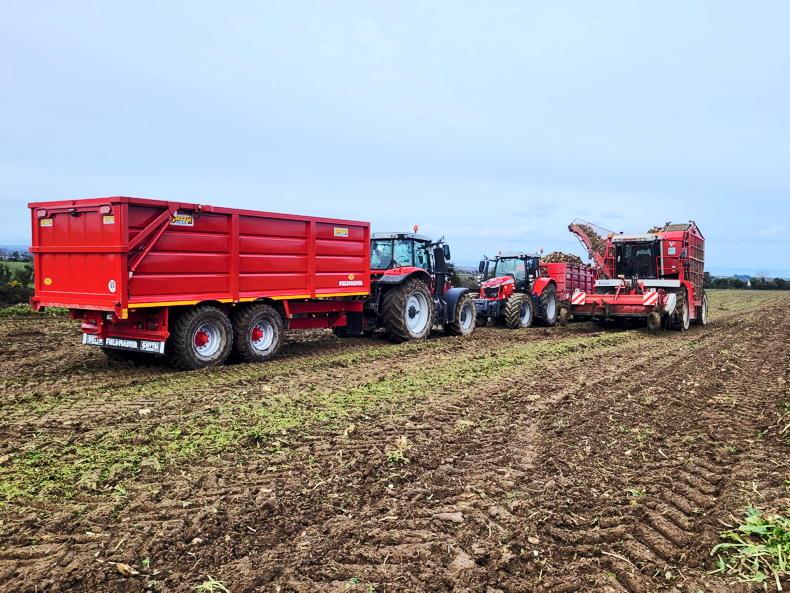
The Dutch-built harvester is powered by a 12.9l DAF engine that churns out 430hp.
In search of the right machine
When upgrading their beet harvesters, the Tallon’s looked at Vervaet, Agrifac and trailed Edenhall machines. They spent time demoing and travelling to both the Netherlands and the UK, in search of the right machine.
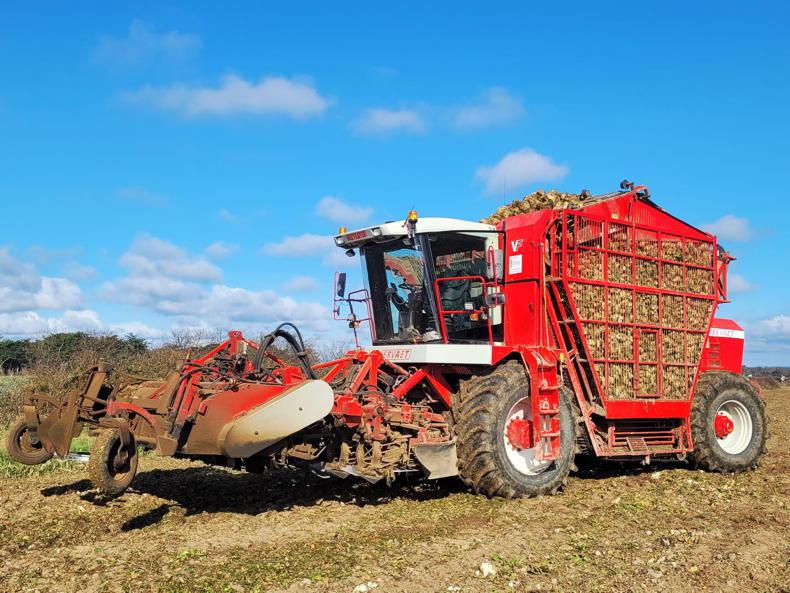
They eventually did a deal with J Riley Beet Harvesters Ltd in the UK, for a 2002 Vervaet 617 ‘beet eater’, which had been fully factory reconditioned. Although not very common in Ireland, the 617 is one of the most popular beet harvesters in the UK. Four years later, the Tallons are delighted with how the machine has performed, and glad they made the decision to go self-propelled.
“We had been thinking of moving to a self-propelled machine for a number of years. The system we were running previous had been working well for so many years, so I suppose we were initially slow to move. We were getting busier and busier each year, and we had less time to spend in the evenings going through maintenance with the trailed harvesters. The trailed machines were very good harvesters, but they were slow to get through work, and they took minding. Labour availability and cost labour was also a factor. With the self-propelled harvester, its so easy to make machine adjustments from the cab and the maintenance work only takes a fraction of the time” explained Andrew.
How does it work?
Starting at the very front, a flail topper chops the leaves off the beet. An auger and spreader distribute these chopped leaves to the left-hand side of the machine. Two support wheels determine the cutting height of the flails. Next up are the scalpers, which cut the heads off the beet. The depth is controlled hydraulically and adjusted from the cab, when the scalpers are in use. However, the flail topper generally does a good enough job, meaning the scalpers are rarely used.
Vibrating shares are used to dig the beet out of the ground. The shares rotate in circular motions and run at 700rpm, meaning each create 23 lifting motions per second. A flicker then feeds the beet onto the lifting turbines.
This machine has one turbine to each row, thus six in total. The lifting turbines pass the beet onto and through six cleaning turbines. The beet is then transferred into the ring trace elevator which rotates clockwise, dropping the beet into the hopper. All machine adjustments can be made from the cab, including the working depth and hydraulic alteration of the rows.
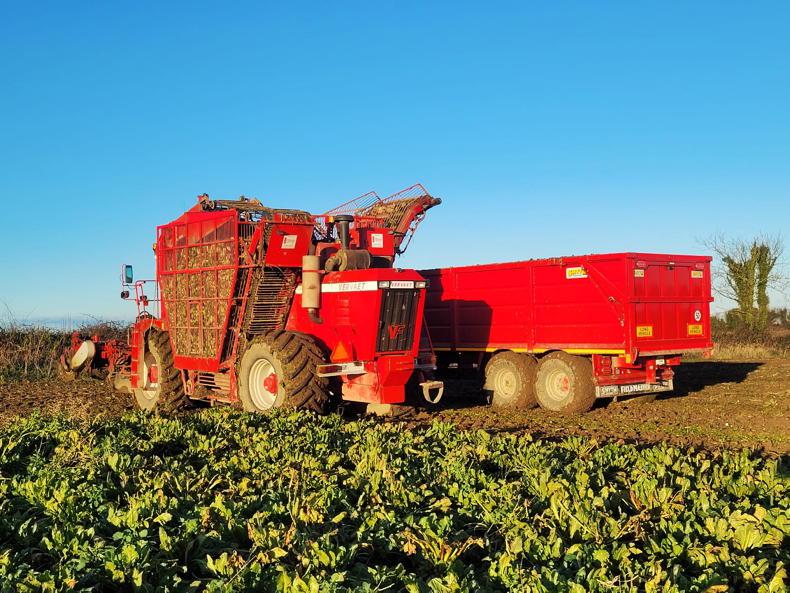
The machine has a 17t hopper and is capable of unloading via a conveyer while on the go.
Unloading
The machine has a 17t hopper, and is capable of unloading via a conveyer while on the go. Andrew explained that as the self-propelled harvester is higher, it has the ability to unload over ditches, whereas his previous trailed harvesters couldn’t. Andrew tends to unload the majority of the beet over the ditches, meaning the trailers don’t bring dirt out onto the roads and he isn’t out every evening cleaning clay off the roads, as was previously the case.
Because the Vervaet holds 17t, he can get away with having just one trailer drawing away in a short draw, instead of two. His previous machines held four to eight tonnes, meaning they didn’t go far without having to be emptied. Andrew explained that the additional carrying capacity of the harvester almost acts as a second trailer. It offers an unloading time of 35 seconds, up to a height of four metres.
Engine and transmission
The Dutch built harvester is powered by a 12.9l DAF engine that churns out 430hp. The machine is hydrostatically driven, featuring a field mode and road mode. In field mode, the machine has a typical working speed of 5-7km/h.
The machine is restricted on the road, with a forward speed of 29km/h in road mode. Equipped with a 970l diesel tank, the machine works at around 2,200rpm, versus the newer machines at 1,400rpm. Fuel consumption equates to around one tank to harvest 30-40 acres, or one and a half day’s work.
The machine is four-wheel steering, and can work in an offset position. Once harvesting, the machine is automatically steered, following the rows of beet. A steering guide located on the topper uses electric sensors and steers the front of the machine while another sensor on steers the rear wheels.
Vervaet source the cab from Claas; it is the same cab that Claas use in its Jaguar self-propelled foragers.
Despite working on mostly good land, Andrew explained that he is very impressed with the machine’s traction capabilities, both on hills and in lower lying fields.
The harvester is running on large flotation tyres, with two 850/60 R38s on the front and two 900/60 R38s on the back.
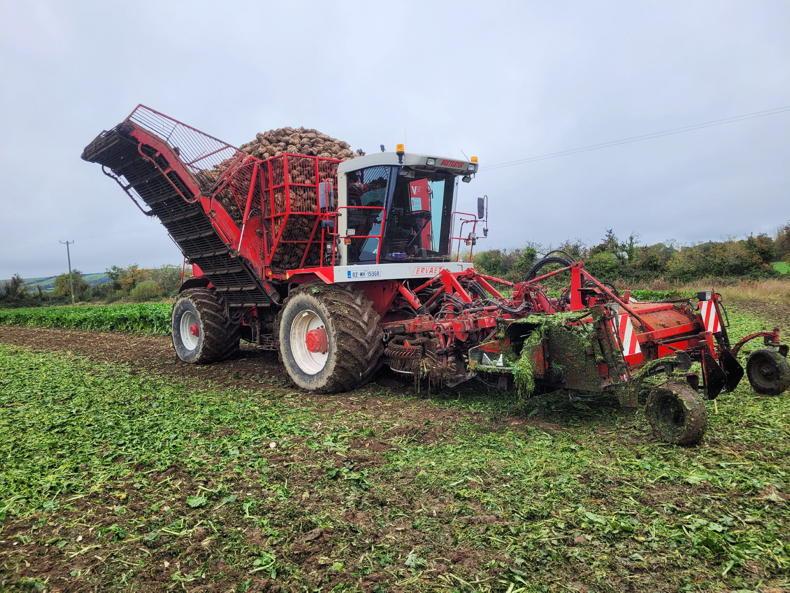
All machine adjustments can be made from the cab, including the working depth and hydraulic alteration of the rows.
Verdict
“We are very happy with the harvester, it has made life so much easier. When we went to harvest with the Thyregod machines, most nights there was maintenance work to be done, to ensure you would be able to stay working the following day. With the Vervaet 617, you do your day’s work and you get home to eat the dinner every night.
“Although the machine is well back the years, so much of the maintenance is streamlined on it compared to the trailed harvesters, such as the auto greaser for example. Previously, we were running two tractors on two harvesters, clocking 1,000 hours on each tractor harvesting beet. To get through the same workload, the Vervaet 617 is doing this in 300 hours.
With the cost of buying and running modern tractors, and the cost of labour, the decision was a no brainer – our only regret was that we didn’t change sooner. Buying the machine off a dealer in the UK was initially a slight concern, but J Riley provide a serious service. Each October, they come over and run through the machine. We bought the 2002 machine in 2022, as a full factory rebuild.
“With the exception of one drive, it hasn’t given a day’s trouble. That drive went on a Tuesday at 4pm. The next day, J Riley had two service men in the field, and we were picking beet again on the Thursday. They answer the phone seven days a week. That gives us great peace of mind.
“Overall, the machine has performed better than we had expected. In the field, it has serious traction and throughput capabilities. The self-propelled brings a lot of advantages over the trailed machine, such as the way we can now split big fields and harvest sections, without having to harvest round and round in the same direction. It has transformed our operation and helped improve our lifestyle. After wet weather, we can allow the ground time to dry, without falling behind on work. The only regret we have is that we didn’t buy it years before,” said Andrew.
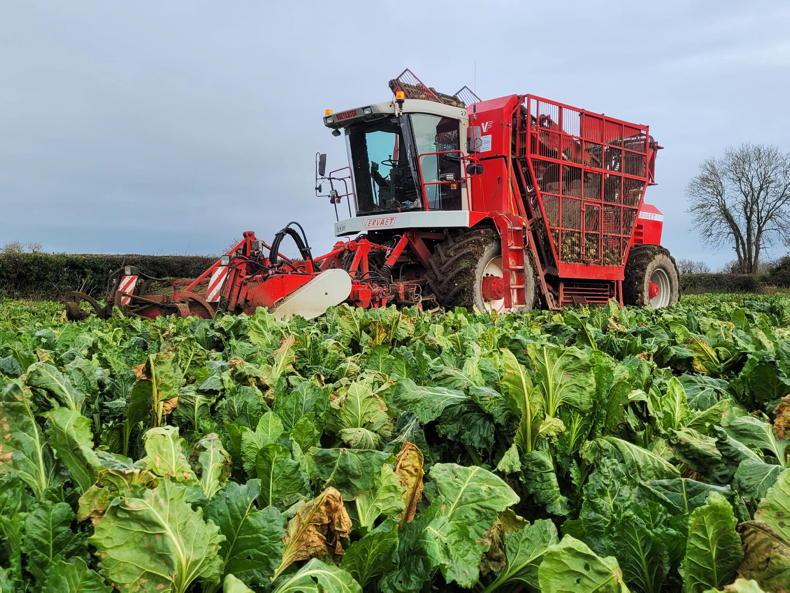
Once harvesting, the machine is automatically steered, following the rows of beet.
Machine specs
Engine: 12.9l DAF. Horsepower: 430hp.Working width: three metres (six rows).Transmission: continuous four-wheel-drive hydrostatic.Fuel tank capacity: 970 litres.Output: two acres/hour.Hopper capacity: 17,000kg.Working speed: 5-7km/h.
Located near Stamullen in Co Meath, Andrew Tallon and his father Brian run a contracting business specialising in tillage works, alongside running their own tillage farm. Although involved in all aspects of tillage, the Tallons specialise in beet and have done so for many years. Brian Tallon first started harvesting beet in the early 1970s with a Ransomes harvester alongside his father, at a time when the sugar beet industry was thriving in Ireland.
As the annual acreage the Tallons harvested increased over the time, the Ransomes harvester was upgraded to an Armer Salmon machine, which remained until 1986. One day Brian went to see a Thyregod harvester in action and was seriously impressed. He made the decision to sell his current machine and upgrade to the Danish-built Thyregod machine.
The closure of the sugar beet factories was major hit to the Tallon’s business, with the acreage of beet planted decreasing rapidly in the early 2000s. However, having stuck with the crop, Andrew and Brian’s acreages has increased steadily over the years. Its current market is predominately livestock feed, with some beet going to feed anaerobic digesters, predominately in the North of Ireland.
Beet acreages vary slightly year to year, depending on rotations, etc, but the Tallons are sowing a steady 350 acres annually, of which 100 acres are for themselves. The beet is planted using a 12-row Stanhay planter.
Thyregod T7s
Up until 2022, the Tallons were operating two Thyregod T7 trailed beet harvesters, a 2001 two-row machine and a 2005 three row machine. The three-row harvester unloaded via conveyor, whereas the other harvester unloaded via a tipping hopper. The Tallons explained that the Thyregod T7 harvesters were ahead of their time in terms of electronics. Inside the cab they had an armrest-mounted control box with a joystick and switches, which control the whole harvester’s functions. The joystick alone had 26 functions, with everything down to work lights being controlled from this box.
The harvesters even had their own hydraulic oil supply on-board, driven via PTO. This supply took care of the whole harvesters hydraulic functions, bar the tipping of the hopper body. Other features they had included sensors placed across the harvester which controlled its automatic functions. Other stand-out features included its variable width axle adjustment. From the cab, the harvester’s axle could be extended to a 13ft wide working position for increased stability and retracted to a 11’6 ft transport position.
The Dutch-built harvester is powered by a 12.9l DAF engine that churns out 430hp.
In search of the right machine
When upgrading their beet harvesters, the Tallon’s looked at Vervaet, Agrifac and trailed Edenhall machines. They spent time demoing and travelling to both the Netherlands and the UK, in search of the right machine.
They eventually did a deal with J Riley Beet Harvesters Ltd in the UK, for a 2002 Vervaet 617 ‘beet eater’, which had been fully factory reconditioned. Although not very common in Ireland, the 617 is one of the most popular beet harvesters in the UK. Four years later, the Tallons are delighted with how the machine has performed, and glad they made the decision to go self-propelled.
“We had been thinking of moving to a self-propelled machine for a number of years. The system we were running previous had been working well for so many years, so I suppose we were initially slow to move. We were getting busier and busier each year, and we had less time to spend in the evenings going through maintenance with the trailed harvesters. The trailed machines were very good harvesters, but they were slow to get through work, and they took minding. Labour availability and cost labour was also a factor. With the self-propelled harvester, its so easy to make machine adjustments from the cab and the maintenance work only takes a fraction of the time” explained Andrew.
How does it work?
Starting at the very front, a flail topper chops the leaves off the beet. An auger and spreader distribute these chopped leaves to the left-hand side of the machine. Two support wheels determine the cutting height of the flails. Next up are the scalpers, which cut the heads off the beet. The depth is controlled hydraulically and adjusted from the cab, when the scalpers are in use. However, the flail topper generally does a good enough job, meaning the scalpers are rarely used.
Vibrating shares are used to dig the beet out of the ground. The shares rotate in circular motions and run at 700rpm, meaning each create 23 lifting motions per second. A flicker then feeds the beet onto the lifting turbines.
This machine has one turbine to each row, thus six in total. The lifting turbines pass the beet onto and through six cleaning turbines. The beet is then transferred into the ring trace elevator which rotates clockwise, dropping the beet into the hopper. All machine adjustments can be made from the cab, including the working depth and hydraulic alteration of the rows.
The machine has a 17t hopper and is capable of unloading via a conveyer while on the go.
Unloading
The machine has a 17t hopper, and is capable of unloading via a conveyer while on the go. Andrew explained that as the self-propelled harvester is higher, it has the ability to unload over ditches, whereas his previous trailed harvesters couldn’t. Andrew tends to unload the majority of the beet over the ditches, meaning the trailers don’t bring dirt out onto the roads and he isn’t out every evening cleaning clay off the roads, as was previously the case.
Because the Vervaet holds 17t, he can get away with having just one trailer drawing away in a short draw, instead of two. His previous machines held four to eight tonnes, meaning they didn’t go far without having to be emptied. Andrew explained that the additional carrying capacity of the harvester almost acts as a second trailer. It offers an unloading time of 35 seconds, up to a height of four metres.
Engine and transmission
The Dutch built harvester is powered by a 12.9l DAF engine that churns out 430hp. The machine is hydrostatically driven, featuring a field mode and road mode. In field mode, the machine has a typical working speed of 5-7km/h.
The machine is restricted on the road, with a forward speed of 29km/h in road mode. Equipped with a 970l diesel tank, the machine works at around 2,200rpm, versus the newer machines at 1,400rpm. Fuel consumption equates to around one tank to harvest 30-40 acres, or one and a half day’s work.
The machine is four-wheel steering, and can work in an offset position. Once harvesting, the machine is automatically steered, following the rows of beet. A steering guide located on the topper uses electric sensors and steers the front of the machine while another sensor on steers the rear wheels.
Vervaet source the cab from Claas; it is the same cab that Claas use in its Jaguar self-propelled foragers.
Despite working on mostly good land, Andrew explained that he is very impressed with the machine’s traction capabilities, both on hills and in lower lying fields.
The harvester is running on large flotation tyres, with two 850/60 R38s on the front and two 900/60 R38s on the back.
All machine adjustments can be made from the cab, including the working depth and hydraulic alteration of the rows.
Verdict
“We are very happy with the harvester, it has made life so much easier. When we went to harvest with the Thyregod machines, most nights there was maintenance work to be done, to ensure you would be able to stay working the following day. With the Vervaet 617, you do your day’s work and you get home to eat the dinner every night.
“Although the machine is well back the years, so much of the maintenance is streamlined on it compared to the trailed harvesters, such as the auto greaser for example. Previously, we were running two tractors on two harvesters, clocking 1,000 hours on each tractor harvesting beet. To get through the same workload, the Vervaet 617 is doing this in 300 hours.
With the cost of buying and running modern tractors, and the cost of labour, the decision was a no brainer – our only regret was that we didn’t change sooner. Buying the machine off a dealer in the UK was initially a slight concern, but J Riley provide a serious service. Each October, they come over and run through the machine. We bought the 2002 machine in 2022, as a full factory rebuild.
“With the exception of one drive, it hasn’t given a day’s trouble. That drive went on a Tuesday at 4pm. The next day, J Riley had two service men in the field, and we were picking beet again on the Thursday. They answer the phone seven days a week. That gives us great peace of mind.
“Overall, the machine has performed better than we had expected. In the field, it has serious traction and throughput capabilities. The self-propelled brings a lot of advantages over the trailed machine, such as the way we can now split big fields and harvest sections, without having to harvest round and round in the same direction. It has transformed our operation and helped improve our lifestyle. After wet weather, we can allow the ground time to dry, without falling behind on work. The only regret we have is that we didn’t buy it years before,” said Andrew.
Once harvesting, the machine is automatically steered, following the rows of beet.
Machine specs
Engine: 12.9l DAF. Horsepower: 430hp.Working width: three metres (six rows).Transmission: continuous four-wheel-drive hydrostatic.Fuel tank capacity: 970 litres.Output: two acres/hour.Hopper capacity: 17,000kg.Working speed: 5-7km/h. 





SHARING OPTIONS